
Original airdate November 7, 2004
Written by Mitchell Hurwitz & Richard Rosenstock
Directed by Lee Shallat-Chemel
Production Code #2AJD01
 DECONSTRUCTION
HIGHLIGHTS
NITPICKS/GAFFES
EPISODE NOTES/TRIVIA
HIDDEN DETAILS
“Following George Sr’s escape, Michael’s decision to start a new life in Phoenix with his son is quickly halted when he learns he cannot leave the state unless he comes up with bail money. Meanwhile, the rest of the family similarly attempt to embark on new beginnings, as Oscar moves into the penthouse with Lucille and Buster, Gob adjusts to his new role as Bluth Company president, and Tobias and Lindsay decide to open up their relationship.”
NOTE: Deconstructing Arrested Development openly discusses spoilers when relevant (which can include episodes that come later in the series). Readers who have not seen the series in its entirety are advised to proceed at their own discretion.
DECONSTRUCTION
The second season can often make or break a series. There are no shortage of tv shows that came out of the gate with excellent first seasons, only to nosedive in quality upon hitting season 2. Much in the same way some authors only have one great novel in them or some bands only have great album, some shows just don’t have the right ingredients to produce multiple great seasons, and many never regain that season 1 magic. Having said that, sometimes the opposite can also be true – there’s a similarly large list of shows that have weak opening seasons and then hit their stride in their second year. Arrested Development was never a candidate for this category, of course, as it was hilarious, fully-formed and fully-realized from day one (not that those early episodes don’t feel a bit different to the rest of the series). But after closing out such an impressive opening season, any cautious viewer would wonder: Can the writers possibly maintain this level of quality for another year’s worth of episodes? Thankfully, Arrested Development avoids the sophomore slump, carrying itself into season 2 with even higher levels of confidence than exhibited in the Pilot. If anything, the run of half-dozen episodes kicked off here (comprising disc 1 on the season 2 dvd) may unequivocally be the strongest batch of episodes in the entire series. In a lot of ways, season 2 really feels like the point when Arrested Development comes into its own and starts operating at full capacity, and many fans consider this season to be the apex of the series.
A season 2 premiere serves a similar function to a show’s second episode: It has to reacquaint returning viewers with the characters/story and make a case for why they should stick around for the season ahead, ideally being able to hook in some new viewers too who missed what came before. Furthermore, if you’re a writer operating within the realm of serialized television, there are multiple different approaches you can take with a season premiere. Do you treat it is a continuation of the previous chapter? The start of a whole new volume? The latter approach seems more logical if you’re especially eager to draw in new viewers, but frankly that doesn’t seem to be at the top of Arrested Development’s priority list in season 2. Over the course of season 1, the writers became steadily aware that the show’s online fanbase was noticing, sharing and discussing all the hidden details and more esoteric jokes/references. Unlike season 1, where the earliest episodes were written with uncertainty as to how they’d be received, an awareness now existed that, yes, at least a portion of the viewers really were noticing and appreciating all the extra miles they were taking. It seems to have motivated the writers to up the ante with this aspect of the show, almost creating a curiosity: “Just what can we slip in and still have people catch?”, with foreshadowing (and other such easter eggs) becoming a much bigger part of the show’s DNA. At the same time, Arrested Development now had a full season of 22 episodes it could call back to, allowing the show to fully indulge its propensity for callbacks. And likewise, things really ramp up this season when it comes to pacing and the sheer quantity of jokes. In a nutshell, the writers went into season 2 trying to make their already-exceptionally-dense creation even denser.
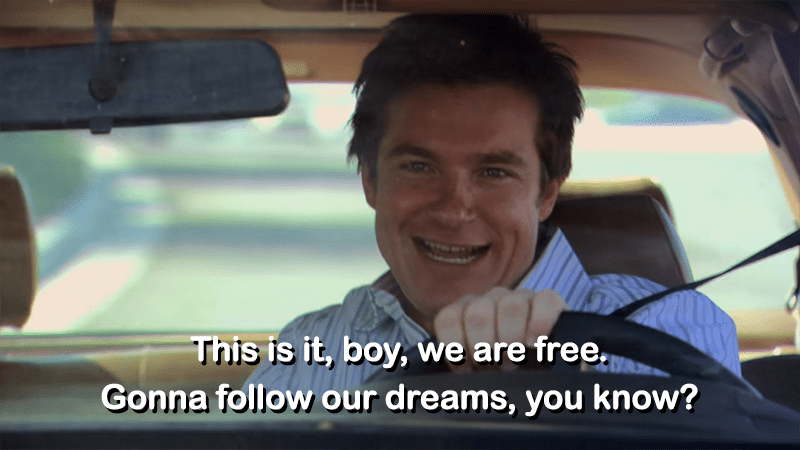
We, the audience, go into season 2 the same way we do every season: Opening on Michael having made some sort of decision to cut himself off from family. We don’t start in medias res as per most other seasons, but there is a comparable “jumping straight into the middle of things” quality about commencing with Michael and George Michael already on the road and making their exit. Sadly, their attempted getaway proves hopelessly hopeless, with Michael’s hubris overtaking him before he can even cross state lines. Michael’s determination to leave ultimately ranks far lower than his determination to make the family aware that he’s leaving, and thus his development is arrested before we’re even two minutes into the episode. It’s a very funny character detail, but it’s also a strategic move from the writers, allowing us to segue straight into a scene with almost the entire cast very early into the episode. Within the first few minutes, we’re immediately reintroduced to the Bluths and refreshed as to the cliffhanger we left off on, and the show is simultaneously able to demonstrate the strength of its ensemble to those who are tuning in for the very first time. It also doesn’t immediately undo the closing moments of season 1, either – that undoing happens a little more gradually, as we expand on Michael’s extensive history of threatening to leave. In the first season, Michael’s arc opens with him deciding to leave, going back on that decision, and then eventually coming full circle to return to that decision again. For all we knew at the end of Let Them Eat Cake, these were the only two occasions in Michael’s life he’d ever considered abandoning the family. But The One Where Michael Leaves quickly recontextualizes these moments, revealing that full circle is, in fact, a perpetual loop; Michael has a longstanding history of threatening to leave. Every time he reaches that boiling point, it’s akin to an interruption from an airhorn or a blender – a short-lived distraction, temporarily upsetting the airwaves before everything returns to how it was moments before.
From here, Michael and his son hit the road once again, but as luck might have it, Michael’s detour may have been a blessing in disguise, as it prevented him from inadvertently criminalizing himself by crossing the border between California and Arizona. After being pulled over by police due to a case of mistaken identity with his now-fugitive father, Michael learns George Sr. has already been caught – and, true to form, turns around again. He quickly discovers it wasn’t his father, but in fact, another case of mistaken identity; the police had actually found George Sr’s identical twin brother Oscar, introduced a few episodes prior in Whistler’s Mother. Barry advises Michael the police plan on holding him soon in his father’s absence unless he can come up with bail money, establishing Michael’s goal for the episode: To get his hands on the company checkbook without giving his family the satisfaction of knowing he needs their help. As far as he wants them to think, he’s still “outta here, seriously” – even if really, the only person he’s fooling with that one is himself. From here, act two is largely just Michael going from family member to family member, trying to ascertain where the checkbook is, and coming to learn that a hell of a lot has happened in their lives during his (hilariously brief) absence. The whole “Michael needs the checkbook” premise is really just another strategic decision from the writers, providing an organic way to visit all the characters and establish everyone’s new circumstances this season. And since “Michael needs the checkbook” is such a straightforward premise to grasp, it allows the focus to be placed squarely on the other characters, as there’s no story-heavy A plot that needs to take precedence during these scenes (rarely the case when we spend this much of an episode following Michael around).
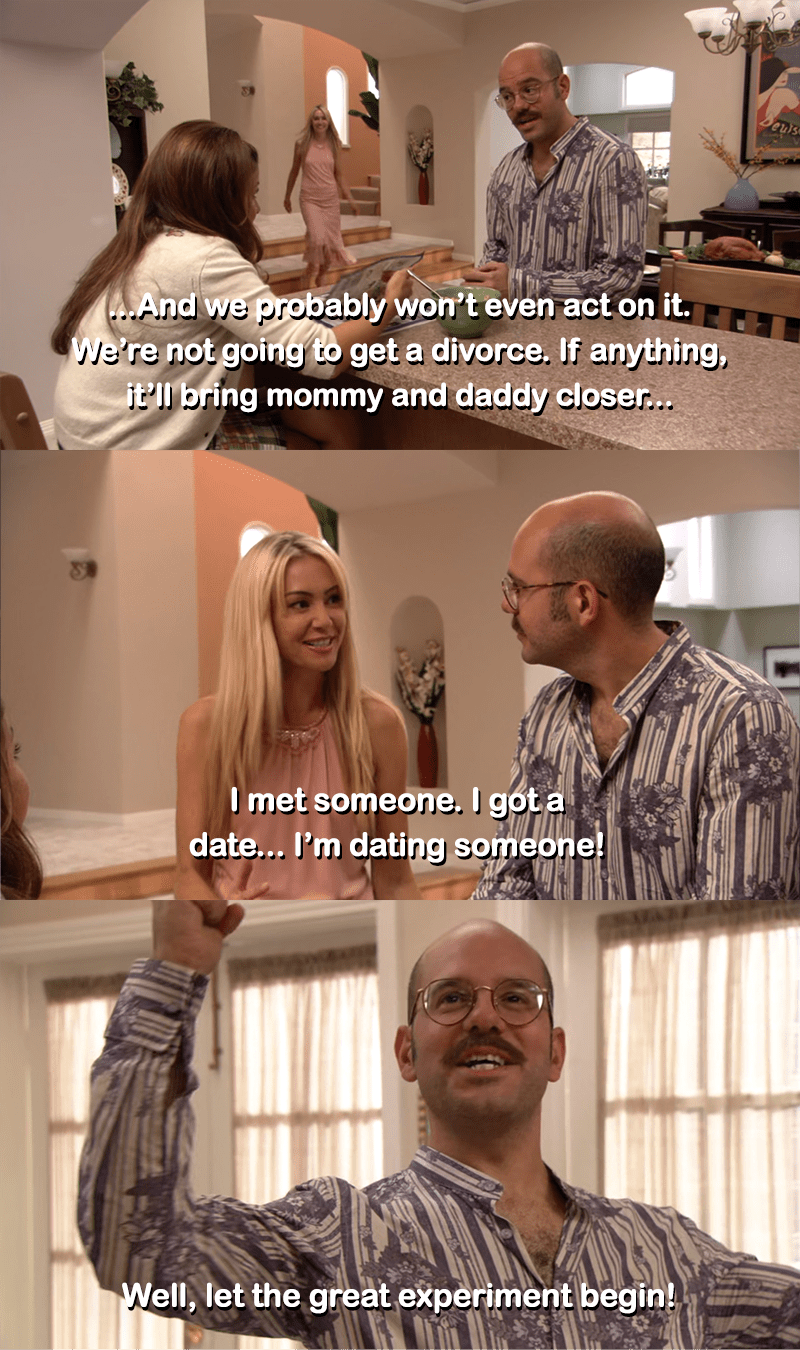
Michael’s first stop is the model home, where he encounters Lindsay on a mission of self-rejuvenation, with news that she is now in an open marriage. It’s a logical place for her and Tobias to have ended up, seeing as just three episodes prior, Lindsay gleefully declared her desire to have an affair. The Fünke marriage doesn’t consist of ups and downs, but rather downs and flat lines, and we’ve spent a whole season watching their relationship flatline. The couple spent a portion of season 1 sleeping in separate bedrooms, Lindsay contemplated divorce in the season finale, and now they’ve reached the stage of desperate last measures. Non-monogamous relationships may not all be inherently doomed (as Tobias amusingly implies right before proposing to try it), but when a couple as dysfunctional and loveless as Tobias and Lindsay decide to take the plunge 14 years into their marriage, after all the marital turmoil we witnessed in the last year alone, it’s very clearly a band-aid solution. No matter – Tobias and Lindsay are both experts in deluding themselves, and they eagerly agree to open up their relationship, no matter how reluctant they may actually be to go through with it. Tellingly, Lindsay kicks things off from here by immediately landing herself (what she believes to be) a date, and Tobias reacts in a way that suggests he’s already regretting the decision – and also makes clear he’ll never admit as such.

As it turns out, Lindsay really could have benefited from a man being more clear about his desires, because her “date” is actually a realtor hired by Gob, and he believes Lindsay is a prospective client looking to buy a house. It’s the kind of misunderstanding this show can always reliably generate laughter from, as the two share double entendre-laden exchanges about property (“I have an open thing going on, too. I’ll give you the address, and you can come by. And I think you’ll really like the neighbors”). But it’s undoubtedly the other half of the Fünke marriage where this episode’s most memorable moments lie, as Tobias’s state of dejection leads him down an unexpected path that has little to do with extra-marital encounters. If it was telling that Lindsay tried to arrange a date on the very first day of her open marriage, it’s even more telling that Tobias instead spends that time becoming fixated on his newest acting pursuit: Becoming a member of the Blue Man Group, having unintentionally caught a performance because he believed them to be a support group for depressed men. As it turns out, this episode actually kicks off multiple story arcs in the Fünke marriage, and Michael is similarly burdened by all of them, whether it’s receiving far too vivid a glimpse into his sister’s sex life, or coming home to find his abode plastered in blue handprints.
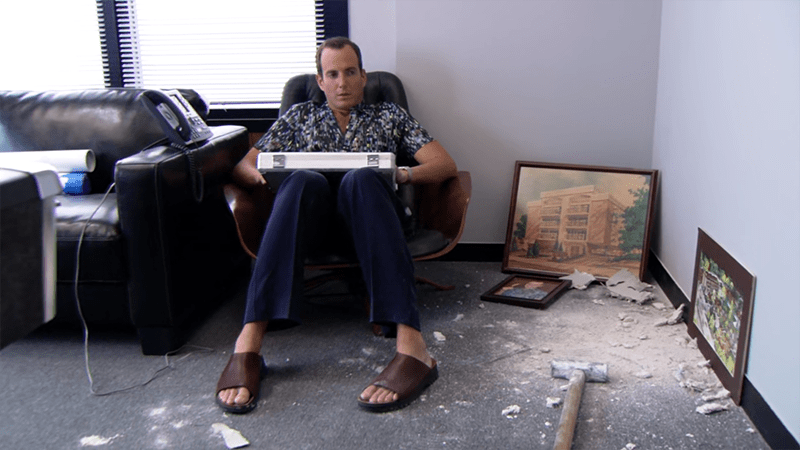
Gob similarly leaves his marks on the walls; mere hours into his tenure as Bluth Company president, he’s already turned Michael’s office into Swiss cheese, hiring a man to take out chunks of the walls with a sledgehammer so he can play an uninterrupted game of pool with no other participants. It plays out much in the same way as Michael’s previous scene with Lindsay, interrupted by multiple cutaways that fill us in on how we got here (one of which is actually a continuation of a cutaway from the previous scene – an editing move that becomes increasingly commonplace the further into the show we get). It largely just serves to establish the “Gob is president” arc that plays out over the next several episodes, though the jokes are still flying so thick and fast that it never really feels like we’re being fed exposition. Once the writers have done elucidating, the focus immediately returns to Michael’s hunt for the checkbook, and the way he attempts to get hands on the it changes with each family member – he didn’t bother feeding Lindsay an excuse, simply telling her he needed it, since he knew she’d be unlikely to question it further. With Gob, however, he dons the guise of being helpful, offering his expertise to assist with the books. But it’s a cover story that proves entirely unnecessary, as Lucille is far too shrewd to ever trust the checkbook to Gob (even if she severely underestimates how much damage he’s still able to do without it).

Even without the breadcrumb trail, Michael definitely would have saved his mother for last – I mean, would you want to ask Lucille for money? This is a woman who manages to suckerpunch Michael with a hilarious quip moments after he walks through the door: “Well, if it isn’t the boy who cried Phoenix.” It’s actually the exact kind of barb Michael himself would throw if the shoe were on the other foot; Lucille and Michael’s shared dry, sly wit being another of the many “like parent, like child” examples throughout the series. Michael makes some bogus ramblings about wanting the checkbook so he can be a role model to Buster, though it wouldn’t have made a difference if Michael had come up with a cover story that actually made sense; his mother sees through his fake smile and overacted enthusiasm immediately. When Lucille doesn’t bite, Michael diverts the conversation to Iraq to remind her that the family’s in crisis (and to refresh the audience on the Saddam Hussein accusations before Gob’s discovery in the Bluth Company walls happens shortly after), hoping this will get Lucille to admit she needs his help. But when point blank asked what he needs, Michael is unable to admit the checkbook falls into that “needs” column, rather than the “wants” as he just claimed, and once again mirrors his mother by refusing to admit he needs her help. It’s a relatively short scene (only about a minute and a half long, 14 lines of dialogue total), but there’s still so much character work crammed into it.
Really though, Michael’s failed efforts with Lucille are all secondary to the scene’s main purpose of catching us up on another plot development, and it’s another way in which the density is amplified this season: The show’s already-large cast increases by one character with the addition of Oscar, now the fourth live-in resident at Lucille’s penthouse. And Balboa Towers isn’t the only thing exceeding capacity now, as the writers seem more determined than ever to give every character something to do (or at least a moment) in every episode this season. While David Cross and Tony Hale sat out several season 1 episodes, there isn’t a single episode in season 2 that doesn’t contain the entire cast – something that can’t be said about any other season of Arrested Development. With 10 Bluths now vying for screentime in each 22-minute installment, this can amount to a considerably high number of subplots at play, and yet it’s rare to see complaints of “too many storylines.” Perhaps this is because Arrested Development has so vehemently made its high density one of its most defining features? Or perhaps it’s because the show uses its screentime so effectively, it rarely feels overstuffed; its density often not becoming apparent until repeat viewings. Oscar’s presence is admittedly minimal here, but he’d provide plenty of material as season 2 continued (beginning, in fact, in the very next episode).

It’s around this point where we close out act two, with multiple characters being confronted by the very things Michael warned them about. Gob realizes he’s in way over his head when he stumbles upon documents he was never meant to see, seemingly confirming his father’s guilt, while Lindsay’s newly-open marriage leads to a moment that leaves her feeling embarrassed in multiple ways, and Lucille sees that the media is not backing down from its investigations into the Bluth Company’s Iraq dealings. This prompts her to make a rash tactical move when later confronted by said media: She signs Buster up to the army, kicking off another of season 2’s ongoing story arcs. It’s a plot development that would be mined for both comedy potential and story potential over a large chunk of the season (Buster’s on/off relationship with the army is actually a major story arc for the series overall, comprising a fair amount of his screentime for seasons 3 and 4 as well) – but much like the other long-form story arcs that are established in this episode, it doesn’t really provide all that much in the way of story here, merely functioning for the purposes of setup. Here Buster is signed up to the army and little more happens story-wise; getting out of the army then becomes his motivation for the foreseeable run of episodes. It all plays very similarly to how things like the banana stand and Gob’s magic career were played in the Pilot; they’re given a few small moments of screentime here so that we’re already informed when the these things come to factor more significantly into the storyline in later episodes. Basically, you’re being invited to the party that is season 2, but all this episode’s doing is giving you all the necessary introductions (exactly what a Pilot does).

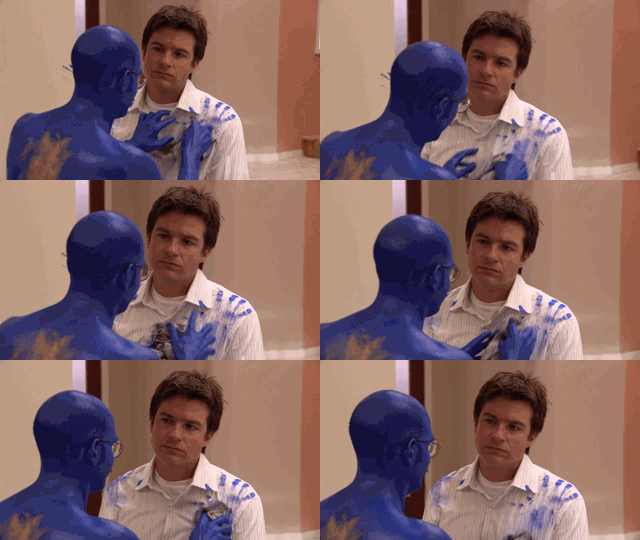
By the time we’ve reached act three, the writers are already spinning gold with Tobias’s newly-introduced story arc arc, leading to both the episode’s funniest scene, and one of the defining images of the series: Michael takes a sledgehammer to the Bluth walls – presumably inspired by Gob – and discovers his brother-in-law painted head-to-toe in blue. David Cross admittedly hated wearing the blue paint, but he’s always believed in the show’s writing and throws himself into whatever material the writers gave him, and his dedication to the bit is what makes it so damn funny. It’s a dedication that seeps out into the character itself; the whole Blue Man Group arc is funny precisely because Tobias is so aggressively dedicated to such a weirdly esoteric life goal, while all it really means for everyone else in Tobias’s life is a whole lot of blue paint getting everywhere (and much like Buster and the army, the Blue Man Group arc also continues to receive callbacks in seasons 3 and 4). Tobias is a character where the writers take some of their biggest creative swings – it doesn’t always pay off (see season 3’s misguided Graft vs. Host story arc), but when it does, it generates some of the show’s funniest material. Material that operates on a unique, absurdist wavelength, not too far from the alternative comedy stylings David Cross is known for. Here, the world of tv comedy is gifted with an instantly amusing visual that would provide a huge amount of comedic mileage throughout season 2. And just minutes into the arc, the writers manage to find a comedic payoff for the blue paint, when Tobias fails to stand out from the night sky as he leaves for his (unsolicited) audition, getting himself run over. And thus, we’re taken to the same endpoint we arrived at in season 1: The entire family is reunited at the hospital.
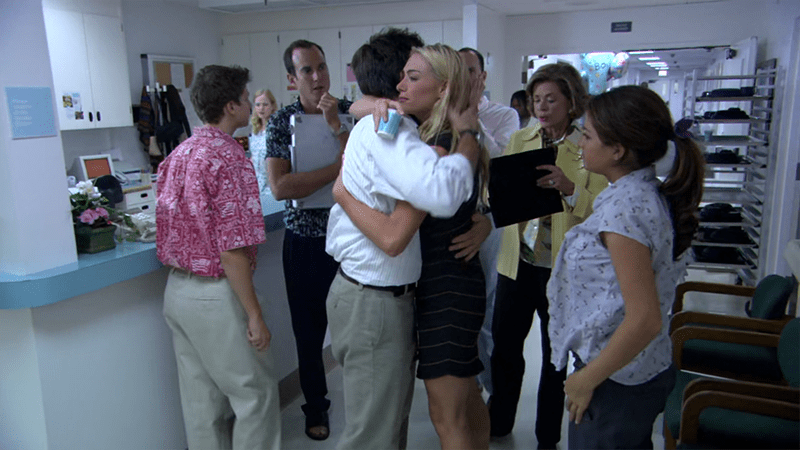
The One Where Michael Leaves, for the most part, is about Michael being unable to leave his family because he actually needs them. Lindsay even says it herself to Michael early in the episode: “Maybe the reason why you always come back is that you need us more than we need you.” If anything in act one sealed Michael’s decision to keep his legal troubles secret, it’s this remark – a dead-on assessment from the most self-absorbed member of the family. The rest of the family’s dependence on Michael lies in more obvious and practical ways (after all, we see here how much destruction happens in Michael’s short absence), while his dependence on them is of a more psychological nature, but whether Michael realizes it or not, he will never have as much value outside of the Bluths as he does within the Bluths. He is only a protagonist when framed in the wider context of the family, because whether Michael wants to admit it or not, he is a Bluth. And he proved it by doing exactly the same thing so many other Bluths did in this episode: By going as long as he possibly could before admitting he needs the other party’s help.
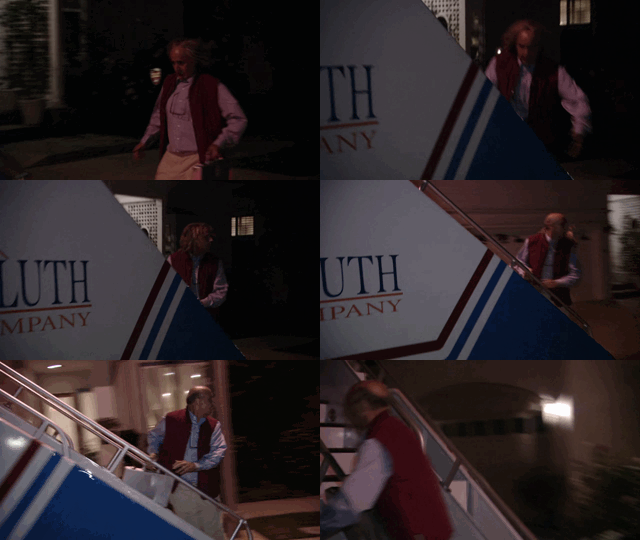
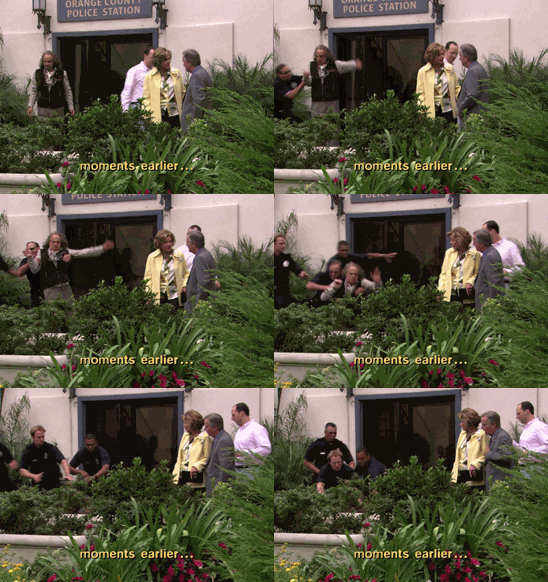
But when Michael finally does, he gets rewarded …briefly; the rest of his family characteristically interrupts and asks for his help first, allowing him to save face and keep a little of the pride he’s fought so hard to hold onto (“Well, I hate to cancel my medical follow-up in Phoenix, but you give me the corporate checkbook, I’ll see what I can do.”). Michael even finds himself in possession of evidence that can exonerate him of wrongdoing and prove his father’s guilt – and he has the rest of his family’s blessing to use it. Unfortunately, it’s a bittersweet moment of victory, as it’s not long before the evidence makes its way into the hands of George Sr. – hiding in plain sight by posing as his twin brother Oscar – who subsequently takes flight with Kitty, only this time he’s also taking the only surefire way to prove his Michael’s innocence. This episode started off by taking the plot point that bookended season 1 (Michael’s decision to leave) and recontextualizing it (these moments were not as impactful as we first thought, because he’s done it a bunch of times before), and it ends the same way season 1 closed out: With George Sr. abandoning his family at the hospital.
Admittedly, all means The One Where Michael Leaves may have the thinnest A story of any episode in the Fox run. The core narrative arc here really just boils down to “Michael needs his family’s help, they need his, both parties are too proud to admit it until they eventually must” – hardly the intricate plotting we’re used to Arrested Development offering up (if anything, that’s the sort of episode arc you’d see in a conventional multi-camera sit-com). The episode’s second act in particular plays more like a season 5 episode, containing multiple one-on-one scenes where characters catch each other up on recent developments, interspersed with flashbacks. While this is a structural device the show usually deploys this very eloquently, it can throw the pacing of an episode off when it’s used in abundance, and just about every scene in act two uses it. In that regard, The One Where Michael Leaves also lacks the show’s usual structural tightness; for most Arrested Development episodes with a 3-act structure, each act takes up a comparable amount of screentime, but here act two clocks in significantly longer than the rest, leaving us with just five minutes for act three.
But The One Where Michael Leaves isn’t structured like most other season 1-3 episodes because it isn’t meant to function as one. The usual care that’d get put into delivering an intricate self-contained storyline amidst the serialization is sidelined here on purpose, because the show’s laying the board for the rest of the season – a board the writers can immediately start playing on from the very next episode. This episode is practically a re-pilot. There is very little resolution at the end of The One Where Michael Leaves, other than Michael’s hopes of a new start being completely snuffed out thanks to his father’s betrayal (and pretty much that entire sentence can also be said of the Pilot). We do, however, close out the episode with a definite sense that a new chapter is underway, with virtually every other Bluth having clear framework for how they’d be spending the next batch of episodes. This episode may spend most of its time setting up arcs for later episodes, but they’re long-running arcs, spanning the entire season (and some continuing beyond it) – so perhaps The One Where Michael Leaves plays best in a binge watch. It certainly plays better on repeat viewings when one knows what’s ahead for the rest of the season.
This approach of giving each season its own unique set of story arcs (while still continuing the overarching story that began in the Pilot) really took off in the 21st century – particularly with cable and streaming shows – and Arrested Development had the formula down pat long before it ever became commonplace for sit-coms. Even many casual fans who don’t know the episodes by names can still easily distinguish season 2 as “the season where George Sr’s living in the attic.” Likewise, other long-form story arcs like the Fünkes’ open marriage are recallable even after individual episode premises fade from memory, because they drive so much of the narrative across so many episodes. These arcs don’t just play out in the background, they’re a constant source of character motivation throughout the whole season, and the writers eagerly welcome the storytelling and jokewriting opportunities these new plotlines present. For a show that’s all about people being rooted in the status quo, Arrested Development frequently relishes the opportunity to make changes to its status quo (as evidenced by the penthouse gaining a fourth live-in resident here – one who’d stick around for an even longer stint than Annyong). Likewise, the reframing of Michael’s threats to leave as a throwaway character trait also allow the writers to have a bit more fun with how they portray Michael this season, letting him slip out of the “straight man/central protagonist” role more often (and it sets a precedent that Arrested Development can keep playing with our understanding of these characters and continue to new information we weren’t privy to before – something the show would continue to do into its very last episodes).
Unfortunately, as is often the case with particularly dense episodes like The One Where Michael Leaves, some of our main characters get a little short-changed for screentime here. George Sr. is practically absent for the entire episode (granted, he’s present for most of the lengthy final scene, but incognito as Oscar, with George Sr’s true identity not being revealed until after he makes his exit;), and Maeby isn’t given much to do beyond react to the unwelcome developments around her. Both of these characters are actually given very little to do over the following episodes too – the events of George Sr’s life on the lam are played with deliberate haziness until a few episodes’ time in Good Grief, and Maeby’s defining arc of the season (arguably series) doesn’t kick off until later this season in Switch Hitter. But George Sr’s final moments here do establish a pivotal theme of season 2, as he goes into hiding with Kitty. That theme of “hiding” has already crept in throughout the episode before this scene, and it guides many of the character arcs this season; Lucille and Oscar spend season 2 hiding a big secret from Buster, Gob tries to hide the fact that he doesn’t know how to do his new job, Tobias and Lindsay’s attempt at polyamory is really just them hiding from their own crumbling marriage, etc. And there are many more examples in later storylines this season too (like the aforementioned Maeby arc). Obviously it’s always been woven into the show’s fabric to some extent – “hiding” runs adjacent to “secrets and lies,” which are already Arrested Development’s narrative bread and butter – but the literal form it comes to take on with George Sr’s circumstances really pushes the theme to the forefront this season.
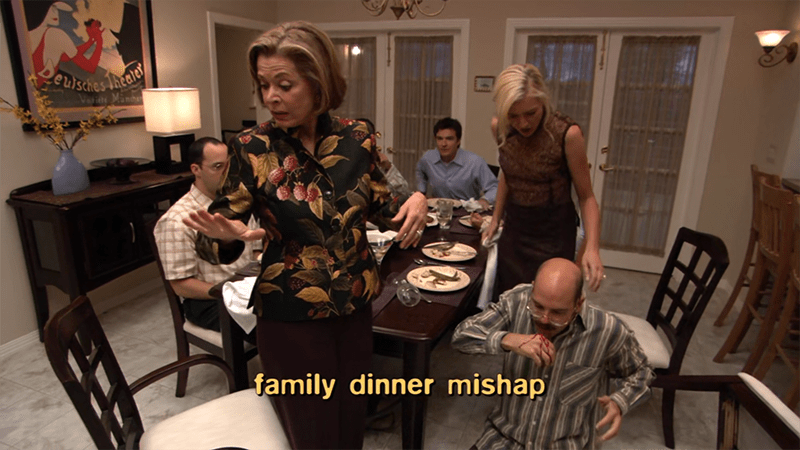
Michael’s habit of threatening to leave is really just a reflection of George Sr’s constant escape attempts. We repeatedly witnessed George Sr. attempting to escape when he was in compromising situations, and Michael has pretty much inherited the same fight-or-flight response (which Gob also exhibits in numerous other episodes). And likewise, his adamance on concealing his vulnerabilities at all times can be found in Lucille, who bears equally as much influence on Michael’s internalized behavioral patterns. Michael’s one of the worst offenders when it comes to letting his pride get in the way of asking for help, or even just admitting he needs it, even though this is the only thing he needs to do to improve his situation here; and vice-versa for most his family. It’s all hitting another one of Arrested Development’s core storytelling principles: Every time this family fails to be honest with each other, it causes them more harm than good. These are all beats the show’s hit before, and honestly, that’s fine for an episode that primarily exists just to set the table for season 2. Our “A-plot” is just a little storyline about Michael looking for a checkbook, but it serves as the catalyst for a whole season’s worth of place-setting, and also reinforces/reintroduces a bunch of the show’s core themes along with it. The A-plot here doesn’t need to be anything more than that; if it were, it would likely just leave all this place-setting feeling rushed instead, and the fact that Michael’s storyline borrows so heavily from the Pilot consciously plays to this show’s themes of repetition.

Really, the main thing this episode tries differently is the much longer, full-scene-length flashbacks, which gives act two in particular a very non-linear flow. Non-linear storytelling is one of the big defining things Arrested Development has brought to the sit-com table; the Pilot opened in medias res and took us on a fractured-but-somehow-coherent 21-minute journey where we frequently jumped back and forth to various points over the episode’s timeline. And season 2 is where the show really strives to find inventive applications for this storytelling device (see Afternoon Delight in a few episodes’ time where various flashbacks scattered throughout the episode all link up to each other, just not in the order presented). The One Where Michael Leaves is practically laying down a mission statement for season 2 as a whole, as if to declare, “Don’t worry, the elements that made this show so defining and singular in season 1 aren’t going away at all, we’re hitting the gas on those even harder this season.” The writers knew fully well the show had found an appreciative audience online and was a critical darling – clearly the low (for their time) ratings weren’t due to poor writing, and clearly there was an audience for the type of show they were making. It’s a wonderful sign of the high respect the show’s writers had for the viewers’ intelligence, trusting we’re all smart enough to follow a non-linear narrative. And given how much more commonplace non-linear narratives have become on television in the 20 years since, it’s one of the big ways Arrested Development was ahead of its time.
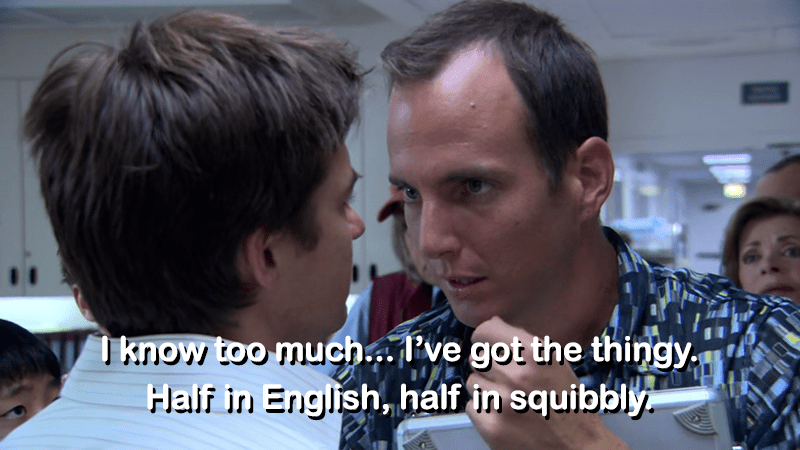
The One Where Michael Leaves feels like one of the show’s most essential episodes when it comes to just how much it sets up, story-wise. Very few episodes do as much place-setting as this one – certainly nothing else in the Fox run. In pretty much every remaining episode this season, at least one plot point introduced here will factor into the narrative (and as mentioned, some story arcs like Buster and the army continue into later seasons too), and in that regard, The One Where Michael Leaves may lay more groundwork for the show than any other episode in the series, save from the obvious exception of the Pilot. And so too, we see Arrested Development setting a new benchmark for the type of show it’s going to be in terms of scene pacing, background details, and callbacks, among some of the show’s other most defining features. Furthermore, all these new shifts to the status quo – such as the addition of Oscar to the penthouse – make a new promise to the audience that Arrested Development Development will deliver us something a little different every season, while still always remaining the same distinct show at its core. For first-time viewers, this episode leaves you unsure where the show’s going to go with any of these new storylines, but confident the laughs-per-minute ratio won’t be dropping any time soon; devotees, however, will know that The One Where Michael Leaves is the start of a very special run of episodes. Hop on the increasingly-accelerating staircar, everyone! The first third of season 2 is Arrested Development at its zenith.
HIGHLIGHTS
MICHAEL: That is not a family, okay? They’re a bunch of greedy, selfish people who have our nose… And Aunt Lindsay.
GEORGE MICHAEL: She’s not my real aunt?
MICHAEL: Not a real nose. Got a picture of her when she’s 14 in a swimming cap, she looks like a falcon.
MICHAEL: I’d like to see the look on their faces right now… (imitating his panicked family) “Where’d he go?”
GEORGE MICHAEL: Or they’d think we just headed home… Actually, you know, that’s kind of what I thought, until I heard about all that Phoenix stuff.
NARRATOR: Michael was concerned that the full impact of his departure might have been lost on his family.
(Michael pulls out his phone and dials Lucille)
LUCILLE: (answers phone) Hello, who is this?
MICHAEL: (putting on a deep voice) Yes, this is Doctor Blumen. I’m calling regarding Michael Bluth.
LUCILLE: Michael! Phone! (puts the phone on the table for Michael, who then hangs up on the other end)
We get the capper to this at the start of the next scene, when Michael arrives at the penthouse some time later:
MICHAEL: Hello, mom. Any messages?
LUCILLE: None.
(Michael picks up the phone to hear the dial tone is still sounding)
LUCILLE: Buster, what are you doing with mother’s rape horn? (turns to Michael) Yes, I have a rape horn, Michael. Because you took away my mace.
BUSTER: Yeah, like anyone would want to “R” her.
After Lucille says of Buster, “Suddenly he’s too much of a big-shot to brush mother’s hair,” Michael stops mid-response to give his little brother this look:
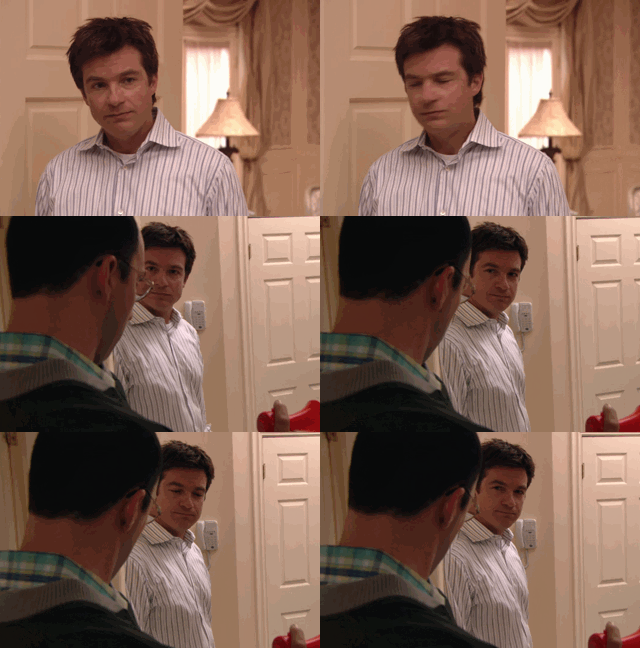
“I came here to tell you that my son and I are…” (Michael is interrupted by Lucille turning the blender on)
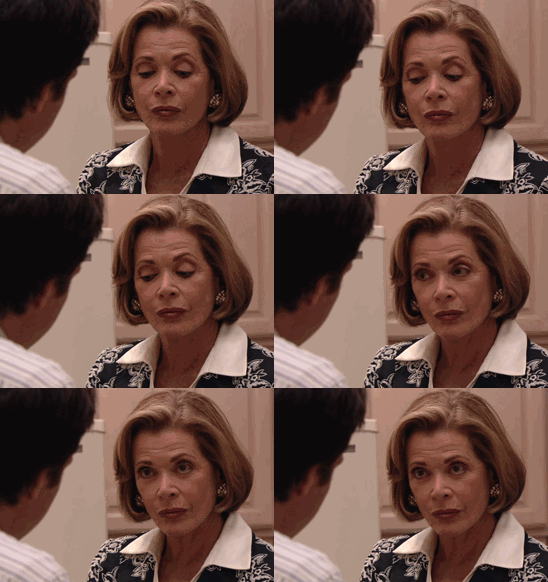
MAEBY: So, you’re really leaving, huh? Have you told your girlfriend Bland? I mean, Ann.
GEORGE MICHAEL: She’s not my girlfriend. And she’s not bland.
MAEBY: Really? Because, I mean, under her school picture, it said, “Not pictured.”
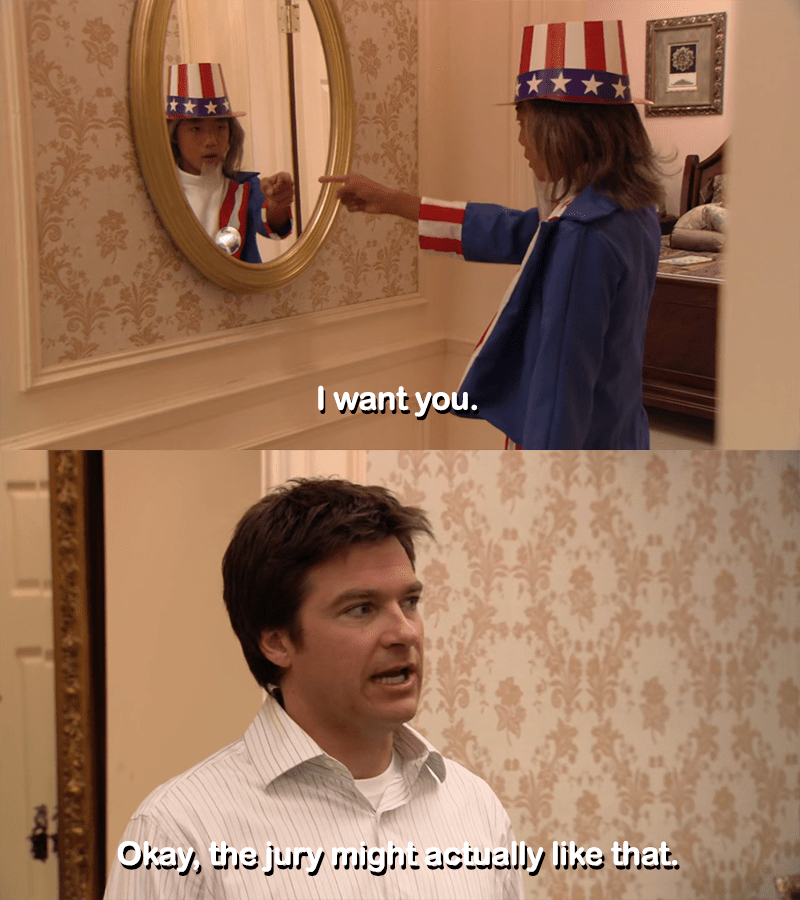
GEORGE MICHAEL: Okay, they printed a retraction in the spring supplement. And yeah, she was really looking forward to seeing me in my Uncle Sam outfit in the get-out-to-vote assembly tomorrow.
MAEBY: Wasn’t that supposed to be before the election?
GEORGE MICHAEL: Yeah, they had to postpone it when that foreign exchange student parked too close to the gym.
ANNYONG: I do it.
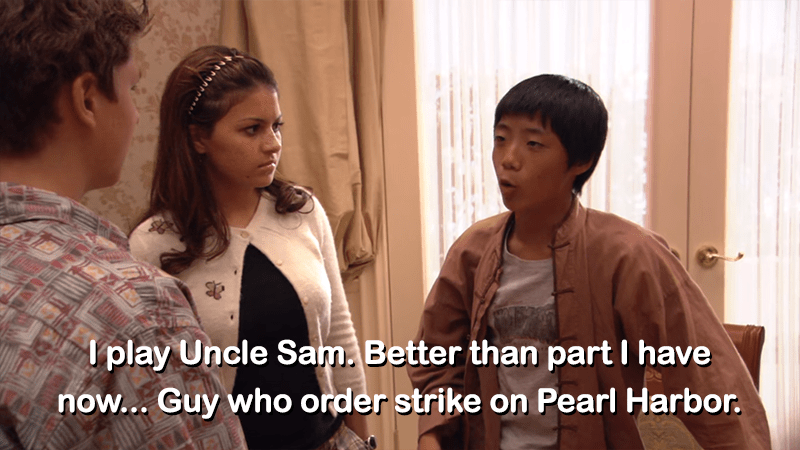
MICHAEL: This time, we’re going to be so far away, you’re never be able to find us.
GEORGE MICHAEL: We’re going to Phoenix.
MICHAEL: Don’t tell them where.
GEORGE MICHAEL: I just thought…
MICHAEL: Doesn’t matter what.
George Michael stumbling over his father’s instructions hearkens back to the Pilot, when he kept failing to correctly identify the “most important thing,” parroting back the wrong lessons to him. It’s a runner that continues throughout this episode too.
Michael drops some harsh truths on his family before he’s outta here, seriously:
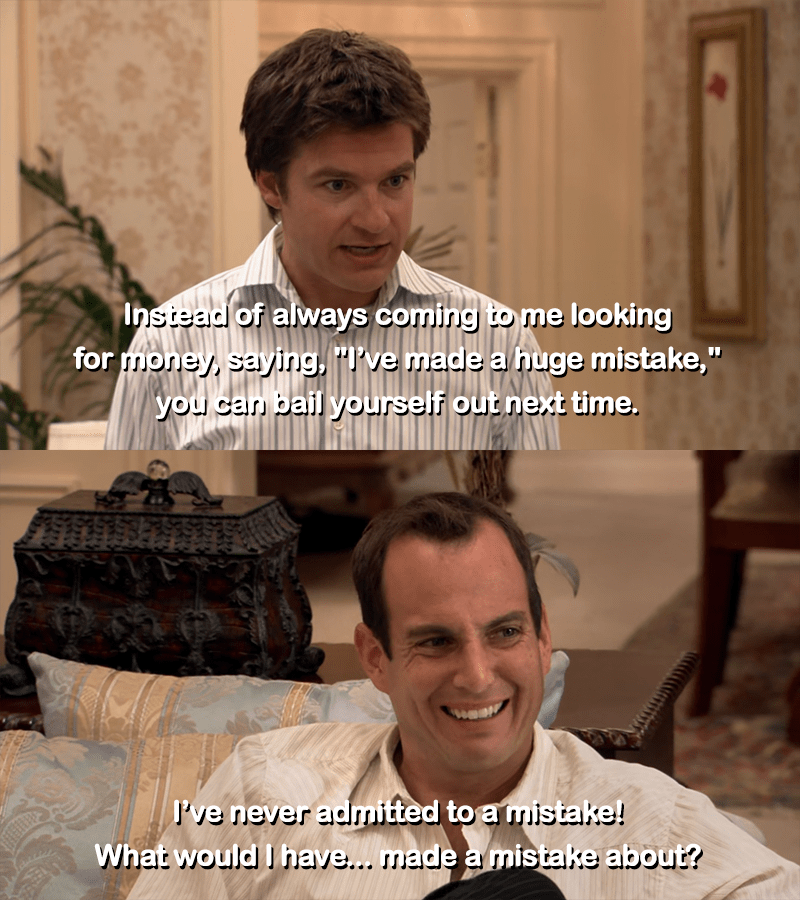
(Gob, however, seizes the opportunity to throw his catch phrase back in Michael’s face at the end of the episode: “You’ve made a huge mistake.”)
GEORGE MICHAEL: (putting on a deep voice while talking on the phone) This is just the lab calling. We’ll give him the bad news in Phoenix. (Hangs up the phone, then says to Michael) They know we’re gone.
MICHAEL: Great… You did say Phoenix again, but what do we care.
GEORGE MICHAEL: Sorry.
Michael still fiercely commits to this ruse of a medical follow-up, despite Lucille not having paid any attention the first time around (much like his insistence on keeping their destination secret, it really doesn’t make any difference to the rest of the family).
MICHAEL: Now, do you want to steer, or are you too old to sit on your pop’s lap and drive?
GEORGE MICHAEL: I think I might be.
MICHAEL: …Okay.
(We smash cut to “a short time later” when the car has been pulled over; the sheriff approaches to reveal an oversized George Michael uncomfortably sat on his father’s lap)
SHERIFF: The car’s registered to George Bluth, so we had to check. He’s been caught, so you’re free to go.
MICHAEL: He’s been caught?
NARRATOR: Michael knew if he went back to see his father, he’d only end up saying something hurtful.
MICHAEL: We’re going back.
Lucille’s way of telling Oscar he can move in: “Fine, but you’re not sleeping in my bed.” Buster and Oscar each think the remark is directed towards them, and nonchalantly try to play it cool:
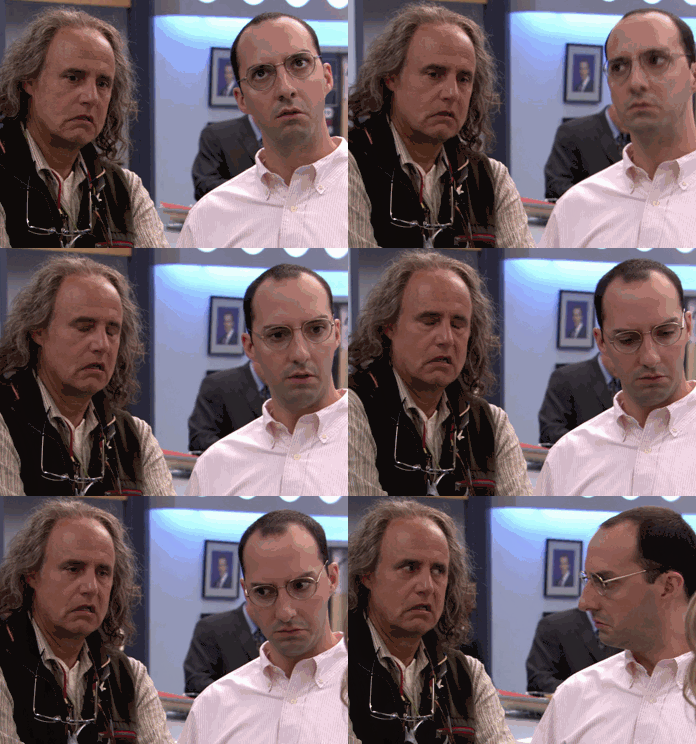
NARRATOR: Soon, Michael arrived to claim his father, and was met by the family attorney, Barry Zuckerkorn.
MICHAEL: (reacting to the large red bump on Barry’s head, while Barry picks at it) Mmm.
BARRY: No, I know, I know! Everybody says, “Leave it alone. leave it alone…” Does this look contagious to you?
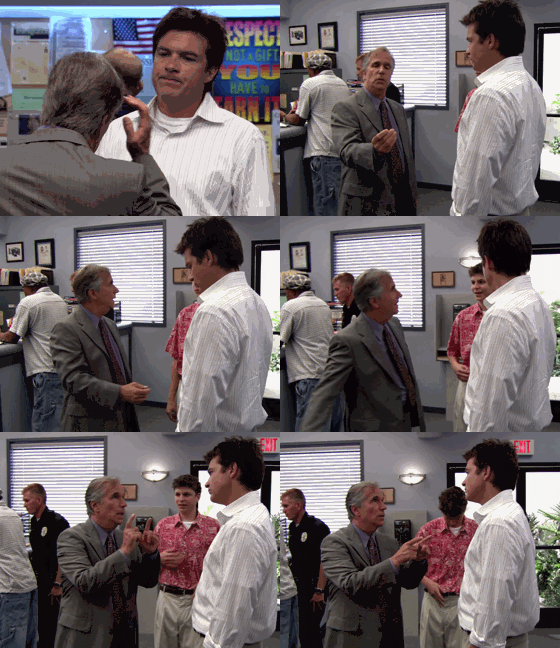
BARRY: Where are you going?
GEORGE MICHAEL: We can’t tell you.
MICHAEL: No, no. We can tell Barry. We’re going to Phoenix.
BARRY: Oh, I wish you hadn’t said that. As your lawyer, I have to inform you you cannot leave the state. I mean, with your father gone, they want to hold you.
MICHAEL: Me?
BARRY: They’re going to indict you tomorrow. All you have to do is come up with the bail. Take it out of the business.
MICHAEL: But I can’t. I quit. I don’t want to follow in my father’s footsteps.
BARRY: Then you might wind up on his cot! Oh man, I wish you hadn’t said Phoenix.
After two slip-ups, George Michael finally remembered Michael’s rule of “don’t tell anyone we’re going to Phoenix,” only to have Michael once again tell him he’s got it wrong. But he’s still not out of the woods yet – another gag from earlier in the episode gets brought into the mix:
MICHAEL: Do you remember what we say about the family?
GEORGE MICHAEL: It’s not aunt Lindsay’s nose.
MICHAEL: Yes, but no.
GEORGE MICHAEL: Don’t tell them we were going to…
MICHAEL: We say that we don’t need them.
GEORGE MICHAEL: Oh!
MICHAEL: Hmm?
GEORGE MICHAEL: Yeah, okay. The new one.
(Michael walks into the living room where Lindsay is sitting on the couch watching an exercise video, consisting of a woman sitting down, giving instructions like “Together, 2, 3, 4, release, 2, 3, 4, tighten, 1, 2…”)
MICHAEL: What are you doing?
LINDSAY: I’m exercising, Michael.
MICHAEL: I see you’ve found an exercise tape made for people as lazy as you are.
LINDSAY: I do have a love life.
(Michael scrutinizes Lindsay’s exercise video further)
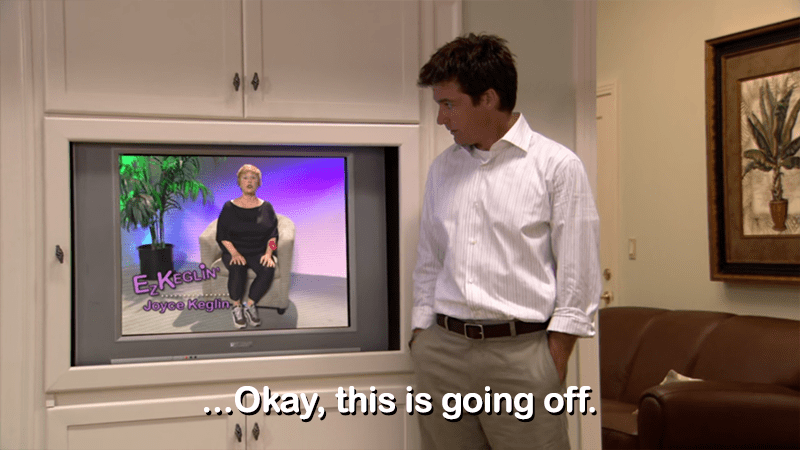
Following this, Lindsay’s flashback scene begins with Tobias watching the same tape in the master bedroom (itself a callback to Michael’s earlier line, “Lindsay, instead of sleeping in twin beds, why don’t you and your husband take the master bedroom”).
David Cross commits to pratfalls like no one else:
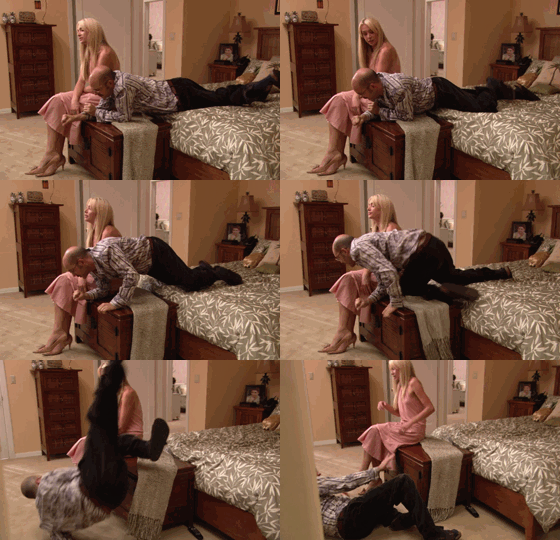
TOBIAS: You know, Lindsay, as a therapist, I have advised a number of couples to explore an open relationship where the couple remains emotionally committed, but free to explore extra-marital encounters.
LINDSAY: Well, did it work for those people?
TOBIAS: No, it never does. I mean, these people somehow delude themselves into thinking it might, but… but it might work for us.
“It’s only been three hours. How much damage could he really do? …And release.”

“In three hours, Gob had done $45,000 in damage.”
BOARD MEMBER: Why should we believe in you?
GOB: For the same reason you should believe a 100 dollar bill is no more than 100 pennies.
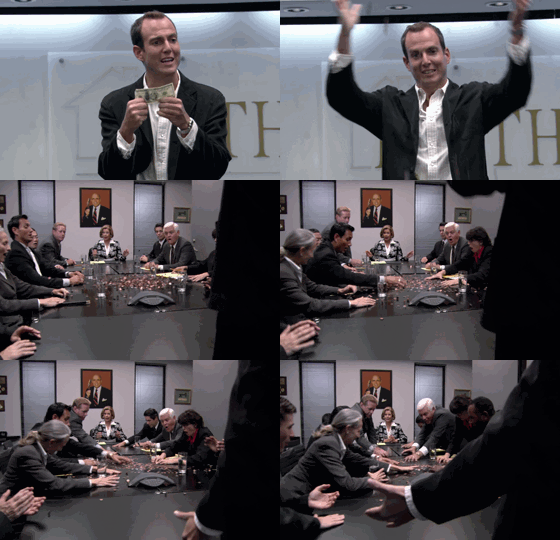
GOB: They approved me unanimously.
MICHAEL: Why wouldn’t they? You’ve only lost them 99 dollars so far.
GOB: So what brings you here, Michael? I hope it’s not for a handout. I run a pretty tight ship around here.
MICHAEL: With a pool table?
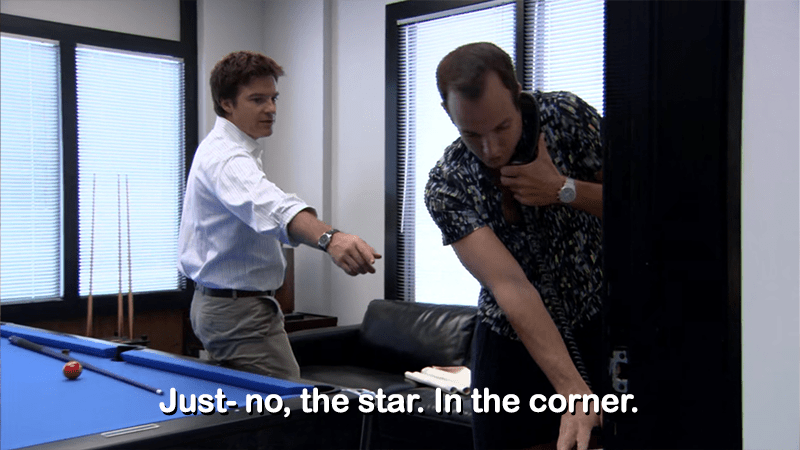
GOB: It’s a gaming ship.
BUSTER: I already have a new role model, Michael.
LUCILLE: His uncle Oscar is living here now.
MICHAEL: Wow, you guys have accomplished a lot in the last three hours.
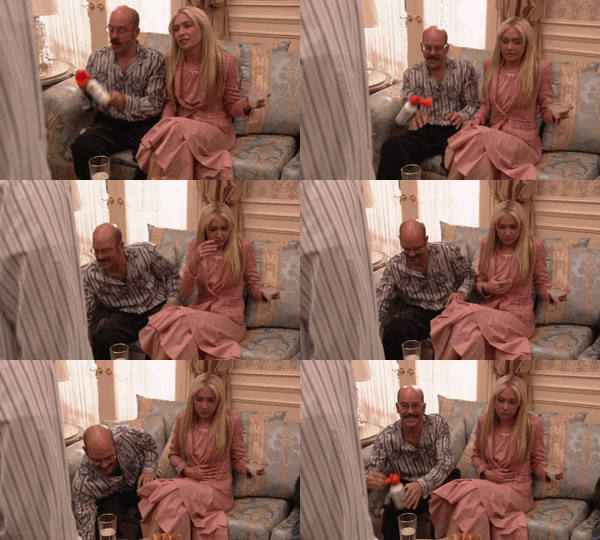
Lucille sends Oscar out for a new airhorn:
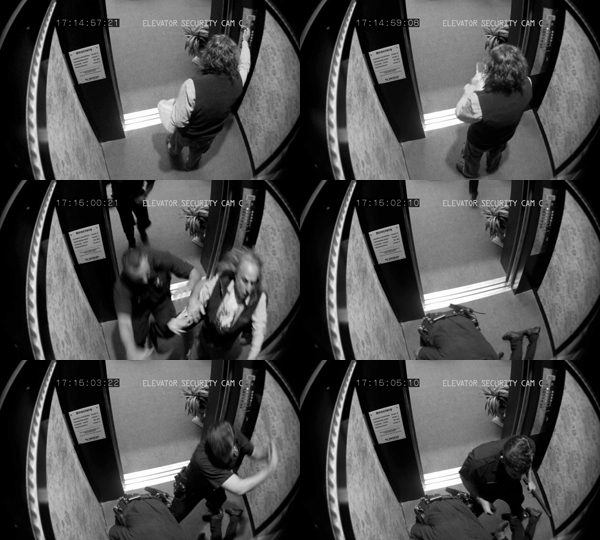
Lucille tells Michael that treason is a “very difficult charge to prove” with a reassuring pair of winks, repositioning himself into his eyeline when he tries to look away:
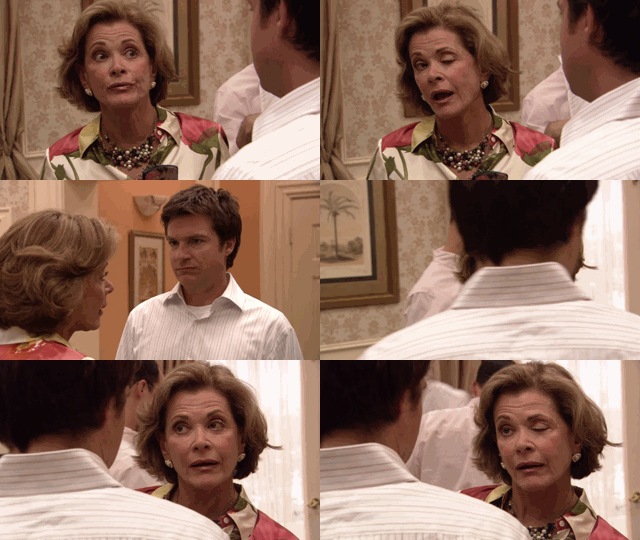
“Man, that jury’s gonna fall in love with you. ”
JAMES: So, should we start in the kitchen?
LINDSAY: I thought, the bedroom.
JAMES: Sure, I’ll meet you up there. I’ve got to make this place smell like cookies. And you should know I am anticipating multiples on this.
LINDSAY: Well, I wouldn’t be doing this if I didn’t think that was a possibility.
(James looks back at Lindsay with a confused reaction, before proceeding to spray cookie-scented air freshener in the kitchen)
The cookie line is then paid off when the “multiples” (as in, other potential buyers) show up and walk in on Lindsay showering; the family patriarch leading his children away with “We’ll go downstairs and have some cookies,” followed by the narrator saying “The kids were in for some bad news too.”
“Tobias, meanwhile, discovered that what he thought was a support group turned out to a team of bald men painted blue.”

(Tobias gets a similarly delighted expression on his face whenever he sees Gob doing magic – basically any form of performing arts makes Tobias giddy with childlike wonder)
DOCUMENTARY FILMMAKER: Your company’s being accused of profiting off of the building of houses in Iraq.
LUCILLE: That’s crazy, we’re all loyal Americans!
DOCUMENTARY FILMMAKER: Oh yeah?

MICHAEL: (sees Tobias is covered in blue paint) Are you blue?
TOBIAS: Only in color, Michael. Only in color… It seems like I might have stumbled upon an acting opportunity.
MICHAEL: As a member of the Blue Man Group?
TOBIAS: Oh, no, you’re thinking of the support group. I made that same mistake myself. They’re called the Blue Man Group. But it’s funny, if I hadn’t sought out a support group, I never would have gotten this gig as an understudy for a performance art group…
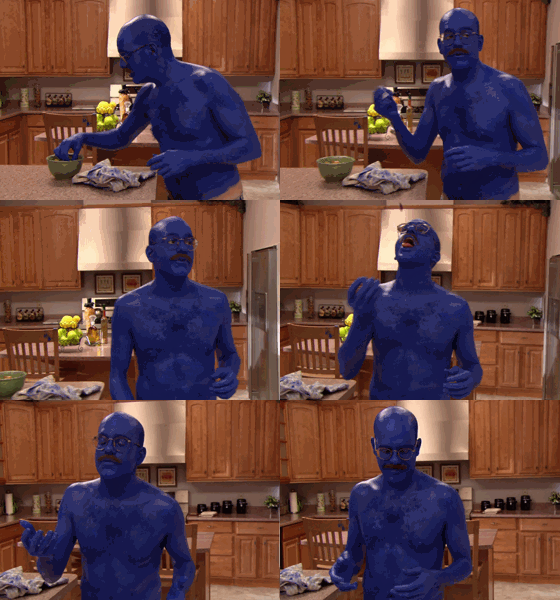
TOBIAS: You know, the universe works in mysterious ways, Michael. You never know where help is going to come from… until you look for it.
MICHAEL: Why does everybody think that I need help?
TOBIAS: (scoffs) Michael, look at you. (puts his hands on Michael’s shoulders, staining his shirt blue) I mean, you’re holding a sledgehammer, your shirt is co- oh, I did that.
(The gag with Tobias failing to catch a peanut in his mouth is further proof that he’d make a terrible addition to the Blue Man Group – catching food in their mouths is a well-established part of their act)
MICHAEL: I need money.
TOBIAS: I can’t help you.
MICHAEL: I know. It did bother me that they did so well without me, but I- I do have to ask them for help.
TOBIAS: And I have to ask for an audition.
MICHAEL: You haven’t auditioned yet?
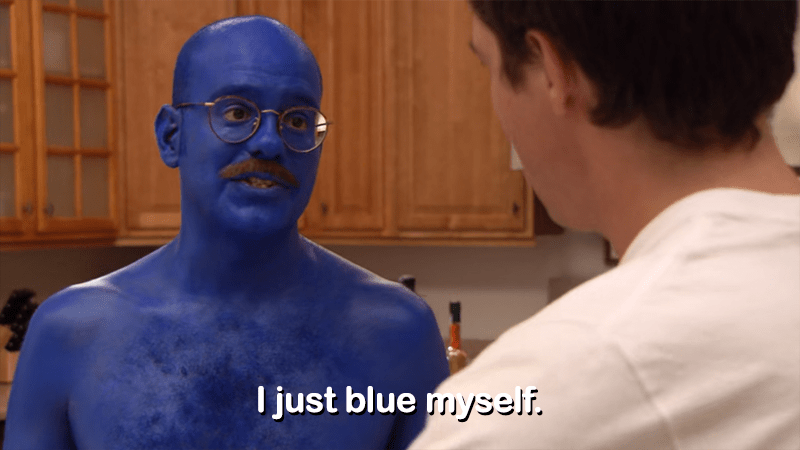
TOBIAS: Oh, no, no. I’m not in the group yet. No, I’m afraid I just blue myself.
MICHAEL: …There’s gotta be a better way to say that.
“Tobias rushed to the theater hoping to be seen. Unfortunately, it was dusk, and he couldn’t be seen.”
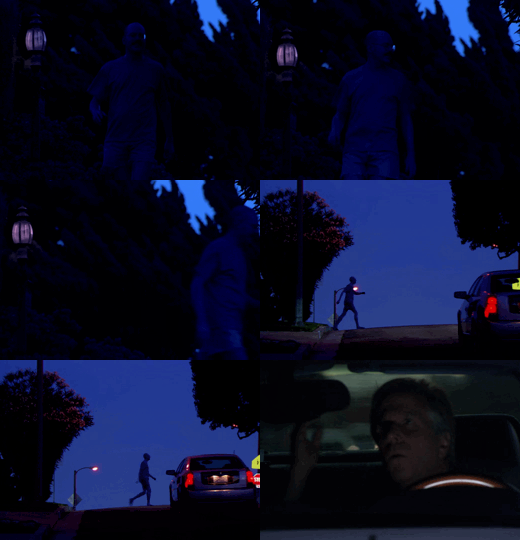
“What the hell was that?!”
MICHAEL: I spoke to him just before he left the house.
LINDSAY: Oh really? What did he say? What was the last thing he said?
“…He said some wonderful things.”
“Mom volunteered me for the army. Just because the fat man dared her to.”
DR. FISHMAN: Excuse me, Mrs. Fünke.
LUCILLE: Oh, this guy again.
MICHAEL: How is he, doctor?
DR. FISHMAN: It… looks like he’s dead.
LUCILLE: Oh my god!
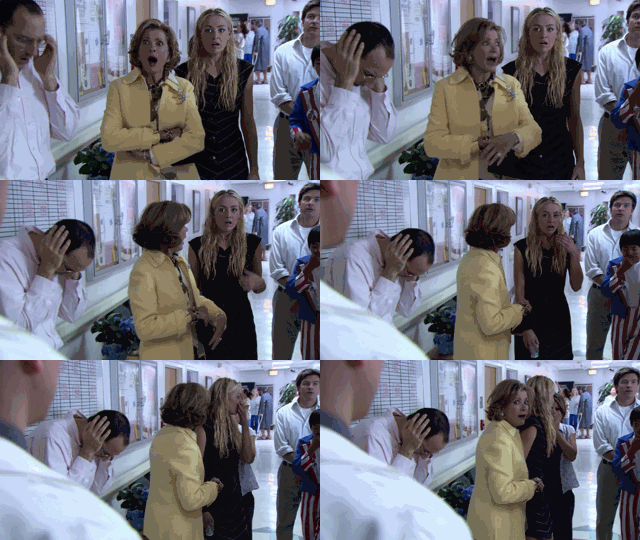
GOB: Oh, little guy… (makes like he’s about to cry) The tears aren’t coming. The tears just aren’t coming!
MICHAEL: Just to be clear. Looks like he’s dead, or he is dead?
DR. FISHMAN: It just looks like he’s dead. He’s got, like, blue paint on him or something. But he’s going to be fine.
(The family’s saddened reaction immediately turns to anger)
GOB: What is wrong with you?!
MAEBY: This *beep*ing doctor!
DR. FISHMAN: …I’ll let you celebrate privately.
LUCILLE: We want this comped!
GOB: We’ve got the proof, Michael. Dad’s signed contract with Saddam.
BUSTER: (leans in to Michael; whispers) Hussein.
ANNYONG: (enters with the Uncle Sam hat in his hands) Hey, look what I found on window sill. Just hat. Someone take wig.
NARRATOR: In fact, it was George Sr. who took wig.
NARRATOR: Lindsay almost stumbles upon a dating opportunity…
DR. FISHMAN: You look really hot.
NARRATOR: …But instead is admitted to the hospital with a fever of 104.
NITPICKS/GAFFES
George Michael’s presence in the back of the sheriff’s car is a bit of a head-scratcher; he isn’t under arrest, but no other explanation is given for why he’s there. One would have to assume there was some additional content written for this scene that didn’t make it into the episode (or the season 2 dvd extras, for that matter).

Oscar can be seen wearing George Sr’s wedding ring in several scenes throughout the episode.
In the flashback to Lindsay and Tobias in the master bedroom, Tobias is initially sitting on the right side of the truck with the remote to his left. In the next shot, he is on the opposite side of the trunk with the remote now behind him.
The aforementioned scene also marks the first instance of one of Arrested Development’s absolute worst trends: Very noticeable ADR (short for “Automated Dialogue Replacement” or “Additional Dialogue Recording” depending on who you ask), more commonly known as “looping.” This is when extra dialogue is recorded at a a later point in time and then laid over a previously-shot scene.
The line in question is Tobias’s “Nice to be back in a queen.” While it’s a funny line, it has a subtly different sound to all the other dialogue in the scene (it is particularly noticeable if you’re watching on a high-quality sound system with a subwoofer, where the low-end noise is boosted significantly). There are several reasons looped dialogue can sound a little different – if it’s being recorded in a sound booth, the room is going to have different acoustics to a set or a location shoot. Likewise, a wide range of things can affect the timbre of a performer’s voice, from sinuses to whatever they last had to eat/drink, which can also contribute to the difference in sound. If different microphones are being used, that may also be a factor, etc. – the list goes on.
Looping is a necessity of filmmaking sometimes, but there are ways to mask the sound differences so they’re not quite as overt, and Arrested Development’s always stick out like a sore thumb. The trend continues all throughout season 2, with at least one instance in almost every episode, and unfortunately remains a common issue in the show, continuing into the revival seasons (the trend really hits its nadir in the back half of season 5, which has multiple scenes consisting almost entirely of looped dialogue).
Midway through the scene in the Bluth Company offices, the setup for the pool table changes significantly. For the first portion of the scene, at least a dozen balls can be seen on the table, and the red “3” ball can be seen in-between the right center pocket and the front-right corner pocket (relative to Michael’s viewpoint). However, after the “I thought you might need me” exchange, that changes – the red “3” is now the only ball sight, and it’s sitting directly alongside the right center pocket.
We see some new footage that’s meant to take place during the Hindsight broadcast in the previous episode – however, the original scene took place during the evening (with visible darkness outside, and most of the house lights switched on) whereas the long shot of Michael watching the tv here appears to take place in the daytime (visible sun shining through the windows and the house lights switched off).

The episode’s timeline contradicts itself repeatedly. There are points where it all seems to be taking place on the same day, with Lindsay mentioning Gob has only been president for three hours (a timeframe that is reiterated both the narrator and Michael). However, Gob tells Michael that he sent the realtor to the model home yesterday, and the flashback scene with Lindsay and Tobias has a caption of “one day earlier.” Similarly, Barry tells Michael “They’re going to indict you tomorrow,” and Michael later says “I’ve got to turn myself in or make bail, maybe by, like, 8 o’clock.” We don’t see any scenes set at night until the final act which supports the theory that this episode all takes place in the same day – though if that’s the case, that would mean a sizeable chunk of the previous episode (pretty much everything from George Sr’s polygraph test onwards) also took place on this same day too, straining plausibility even further. Neither explanation really holds up.
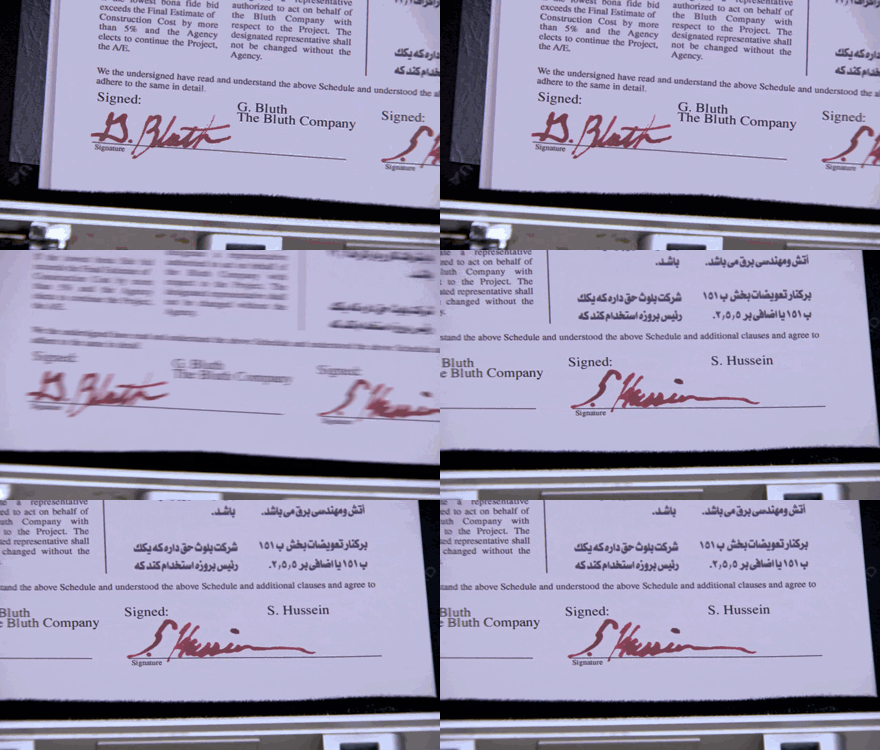
The text on the Bluth/Hussein contract is in Persian rather than Arabic.
When the family exits the bathroom after walking in on Lindsay showering, a reflection of someone sitting (possibly a crew member) can briefly be seen in the mirror. While it appears to most likely be a gaffe, the visual does take on an amusing new context if you choose to instead interpret it as “this is another prospective buyer, sitting and waiting their turn for the shower.”
EPISODE NOTES/TRIVIA
This is the season 2 premiere, making it the first episode to have a production code beginning with “2ACV.” It marked Arrested Development’s return to its regular Sunday night timeslot on Fox, following a five month absence between seasons.
The episode title is a reference to Friends, which titled its episodes in a similar manner (almost every episode title of Friends begins with “The One Where…” or “The One With…”). The subsequent episode also follows suit, then the gag culminates with the title of the third episode, ¡Amigos! – Spanish for “Friends!” It is not clear why this running joke with the titles was done with these three episodes specifically, since nothing else ties these these episodes to Friends (perhaps it was the writing staff’s smartass way of responding to network notes that the show “be more like Friends?”).
The title is actually a bit misleading, as Michael doesn’t successfully leave, nor is this the only episode where he attempts to do so (the closest he comes is in season 4’s Flight of the Phoenix, where he at least makes it out of the state… briefly). The same could also be said of the next episode, The One Where They Build a House – it very much does not end with a house being built.
While Let Them Eat Cake and The One Where Michael Leaves are not “officially” considered to be one of the show’s two-parters (like, say, the Maggie Lizer episodes), numerous tv guides circa 2004 labelled them as such, presumably due to the cliffhanger nature of Let Them Eat Cake’s ending. Narrative-wise, this episode really isn’t a concluding installment at all, it’s very much an opening chapter.
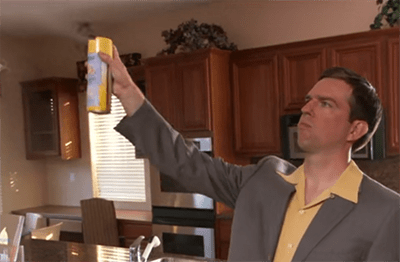
Ed Helms makes his first appearance as realtor James Carr. These days, Helms is best known for his roles in The Office and The Hangover films, though at the time of this episode’s release, tv comedy fans would’ve recognized him from The Daily Show, where he served as a correspondent on over 200 episodes between 2002 and 2009 (he’s the third cast member from The Daily Show to have guest starred on Arrested Development, after Stacey Grenrock-Woods and Michael Blieden). Other notable works of Ed Helms include Rutherford Falls, Cedar Rapids and We’re the Millers. While this is Ed Helms’ only appearance in the Fox run, he would later reprise the role in season 4 episodes Indian Takers and A New Start, with the character being killed off in the latter episode. The character is credited here only as “James,” not actually being given a surname until season 4.
Recurring cast members Henry Winkler (Barry Zuckerkorn), Ian Roberts (Dr. Fishman), Jay Johnston (Officer Taylor), John Beard (himself) and Justin Lee (Annyong) also return. Fans of It’s Always Sunny in Philadelphia will likely recognize Lynne Marie Stewart (who plays Charlie’s mom, Bonnie Kelly) as Joyce Keglin, the instructor on Lindsay’s kegel video. As for the rest of the extended cast, we have Mari Ueda as the barista who serves Oscar, Tracy Howe as the sheriff who pulls Michael over, Steve Tom as the board member who questions Gob, and Bill Rutkoski as the father who walks in on Lindsay showering. Uncredited appearances include Mike Randlema as the Michael Moore look-alike (it’s quite unusual for someone to have multiple lines and not receive a credit), and Erik Saari as Dr. Hate.
In the deconstruction, it was mentioned that The One Where Michael leave makes a point of reintroducing the family early on and reestablishing all the plot points that were left lingering. Very early into the episode, the writers do just this, and also reacquaint us with another one of Arrested Development’s stylistic idiosyncrasies: The documentary framing device, in the form of ATM footage and a traffic light photo.

We’re also given a flashback to the “We lost him” scene from the previous episode, which sets up Dr. Fishman’s literal way of phrasing news to patients’ family members as a running gag for the final act, where it takes its next incarnation: “It looks like he’s dead.”
(Furthermore, the traffic light photo is bookended with the season 2 finale The Righteous Brothers, where another traffic light photo of the staircar becomes a major plot point)
Very early in the episode, George Michael asks his dad, “Don’t you always say family first?” This is indeed something Michael says to his son in the Pilot (the phrase is uttered towards the end of the episode when the family’s playing Monopoly, though it’s essentially just another way of wording the message from Michael and George Michael’s first scene; family is the “most important thing”).
Buster abbreviates “rape” to the letter “R,” the same way he abbreviated “screwing” to “essing” in Pier Pressure. He would also later abbreviate “bitch” to “B” later this season in Ready, Aim, Marry Me.
Maeby mentions that under Ann’s school picture, it says “Not pictured.” Later this season, in Sad Sad, we see Ann’s yearbook picture, and it is indeed captioned as such.
 The Sheriff says Michael was pulled over because his car was registered to George Bluth. This ownership of the vehicle was established in Charity Drive.
This episode kicks off the running joke where Oscar keeps deploying very obvious hints that he is Buster’s biological father (which Buster completely misses), underscored by a sting of cheesy soap opera music, and often followed by characters rolling their eyes.
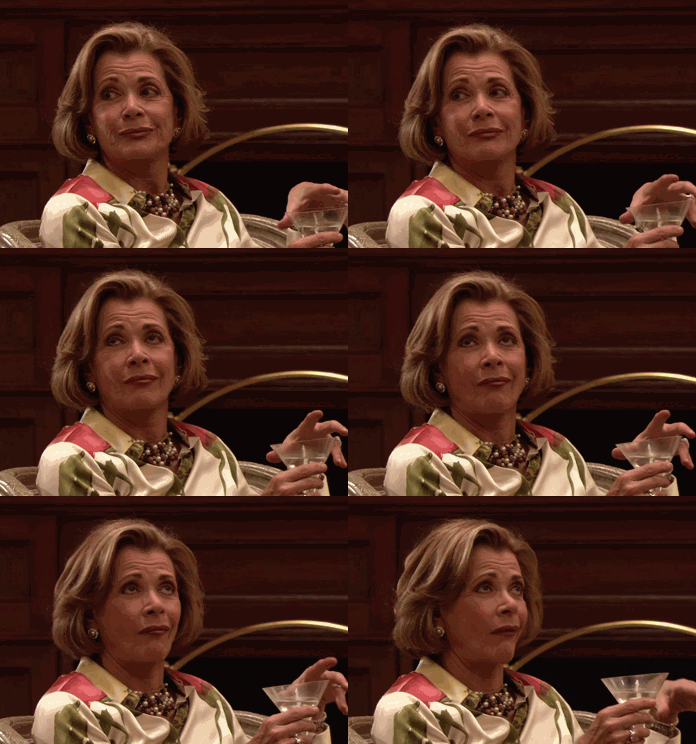
Lucille’s presence at the head of the Bluth Company board table was established late last season in Whistler’s Mother. This is our first team seeing her in a board meeting outside of that episode.
Gob would once again win over the board members by raining pennies down on the desk in the very next episode, The One Where Michael Leaves. He attempts the penny trick again twice more in season 3’s For British Eyes Only and Making a Stand, though those instances would both prove unsuccessful.
Likewise, Gob’s inability to use the office phone is also displayed again in the next episode.
Lucille’s exaggerated winking to Michael is a callback to the Pilot (doubly so because, not only does it happen twice, but the moment’s once again taking place with the same characters in the same location).
Gob sits in silence for exactly seven minutes after discovering the Saddam Hussein documents. This is a reference to George W. Bush, who sat reading to children for seven minutes after learning of the 9/11 attacks (as mentioned in previous deconstructions, there are numerous allusions to the Bush administration throughout the series – extending right to the names of multiple main characters). Coupled with the references to Chemical Ali and Michael Moore’s Fahrenheit 9/11 this episode, the show has an increasingly political bent this season.
When Michael encounters Tobias painted in blue, multiple blue paint stains and handprints can be seen around the model home in the background. This gag continues throughout the entire first half of the season. The hole Michael puts in the wall also remains there for the entire season, though is covered with a cabinet from the next episode onwards.
Tobias appropriates his old cut-offs for his Blue Man get-up (though he would not officially become a never-nude again until a few episodes later, in Sad Sack).
This is the second time Michael’s had to change a shirt after a family member stained it with paint; Gob did the same to him back in Missing Kitty.
Another running gag begins here, where Tobias keeps winding up in the hospital, having sustained horrific injuries. It is repeated in both of the subsequent episodes, and again in Afternoon Delight, before being reprised in season 4’s A New Start. He is also badly injured in Queen for a Day and The Ocean Walker (not to mention the slew of health complications that arise from his hair plugs across the first half of season 3) and is briefly beaten up in The Fallout, though these episodes don’t contain hospital visits.
Michael’s line, “He said some wonderful things,” was previously uttered in Visiting Ours (following a similarly inappropriate flashback of George Sr. saying “Daddy horny, Michael”).
George Sr. would don a wig to pose as Oscar again this season in Sad Sack and Out on a Limb.
The season 5 episode Everyone Gets Atrophy follows a similar framework to The One Where Michael Leaves; Michael briefly stalls his plans to leave, reuniting with the family where he (and the audience) gets caught up on everyone’s new story arcs for the season. While the links between this episode and the Pilot are more overt and deliberate, Everyone Gets Atrophy is probably the episode that can be likened more closely.
The show’s composer, David Schwartz, seems to be trying something a little different this season. While season 1’s upbeat score often relied heavily on string instruments like ukuleles, this season’s has a more vaudevillian sound, with greater emphasis on wind instruments. The soundtrack still very much possesses the same general cadence, but the new stylistic elements introduced here are noticeable. However, numerous pieces of music from season 1 still remain in regular rotation this season (and likewise, many of the new pieces heard this season continue to pop up in later seasons too).
The One Where Michael Leaves has a total runtime of 21 minutes and 54 seconds, and is rated TV-PG.
There are no deleted/extended scenes for this episode.
HIDDEN DETAILS
We have one of our first hints that Lindsay is adopted, in the form of George Michael’s line, “She’s not my real aunt?”
The Blue Man Group story arc is foreshadowed in the opening scene when Michael calls up Lucille under the pseudonym of “Dr. Blumen,” a homonym for “blue man.”
Lucille claims she has a rape horn because Michael took away her mace. We previously saw her spraying an innocent civilian with mace in Visiting Ours – presumably the reason Michael confiscated it.
Early on, Lucille mentions that Buster now refuses to brush her hair (something he’s willing to do for Oscar, as we see later). Lucille’s hair then gets increasingly messier-looking as the episode progresses, and we also see her haphazardly attempting to brush her own hair in act two.
In the cutaway to Gob’s illusion-gone-awry at the Christmas party, Michael is shown locked inside a trunk.
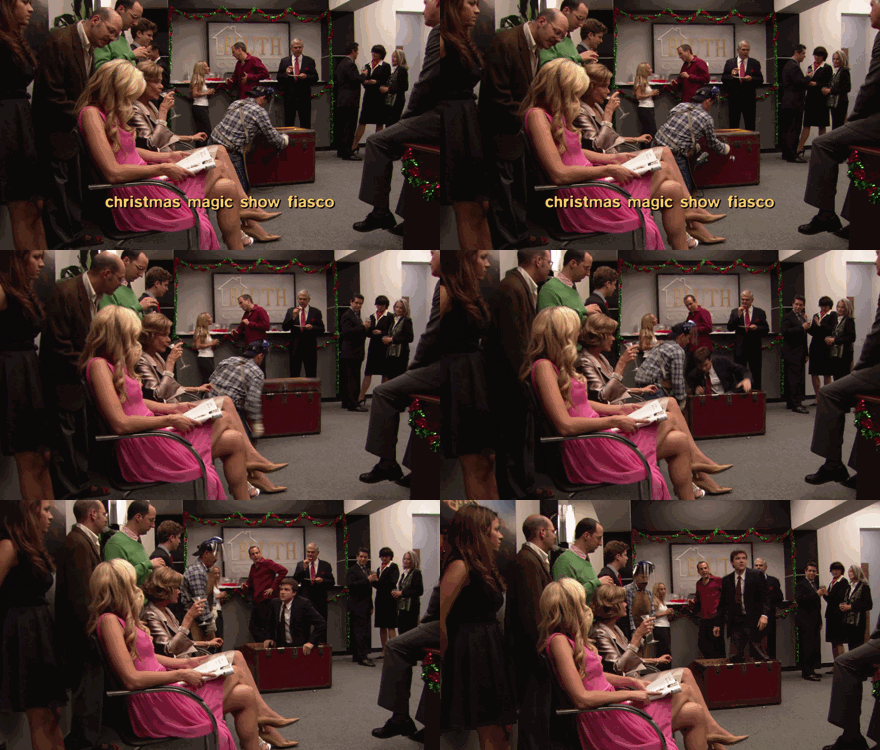
It’s actually the same trunk Earl Milford hid inside in season 1’s Public Relations. The interior/exterior matches (this also indicates Gob continued to the use the trunk in his act after this incident happened, since Public Relations takes place after the most recent Christmas to have passed)
The Monkey Freedom Rally cutaway enforces Lindsay’s ignorance towards nature – orangutans are not monkeys:

Additionally, Lindsay’s shirt reads “H.O.O.P.”, calling back to her anti-circumcision movement mentioned in the Pilot.
When George Michael explains why he told the family they’re moving to Phoenix, Michael cuts him off with “Doesn’t matter what.” He previously cut George Michael off in a similar manner (saying “Doesn’t matter who”) when he appointed him to Mr. Manager in Top Banana.
George Michael keeps staring at Lindsay’s nose in the penthouse, following the information he learned from Michael earlier about her nose job.
This line is one of the more damning pieces of character evidence for the central murder mystery of seasons 4-5:
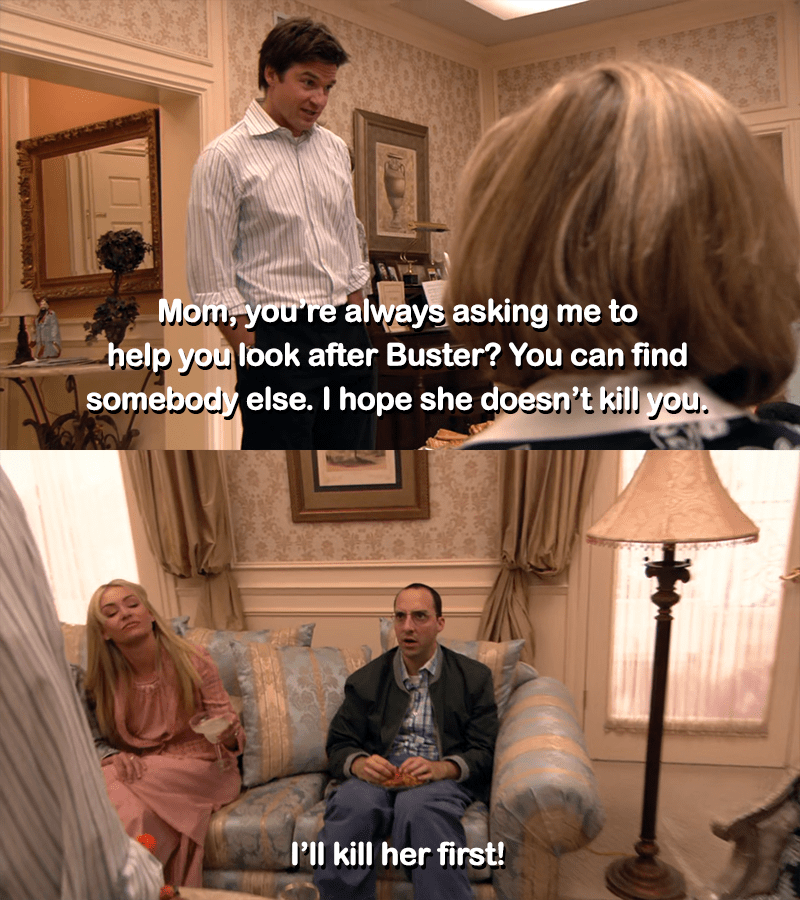
It also receives an amusing in-episode callback:
NARRATOR: Michael now had the distasteful choice of either asking his mother for money or going to jail.
MICHAEL: …Maybe Buster killed her already.
When Michael says “Good luck trying to find someone else to run the business, by the way,” his next sentence immediately begins with the word “Gob,” subtly foreshadowing Gob becoming the new Bluth Company president later in the episode.
Whenever Oscar is arrested, it always begins with multiple cops piling on him, and always ends with Officer Taylor clubbing him over the head with his baton and yelling “Yeah!” This happens four times over the course of the episode (the last instance actually being George Sr. posing as Oscar).
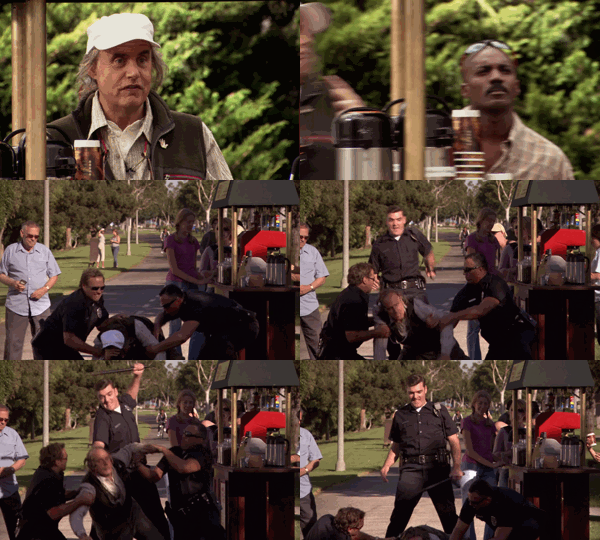
The episode wastes no time in clueing the audience in that Oscar is Buster’s real father, beginning when Lucille rebuffs his physical advances at the police station:
LUCILLE: What is wrong with you? The boy is here.
BUSTER: Oh! They said my father was here.
OSCAR: Did they? (soap opera music sting plays)
And again later in the same scene, with the “father figure” moment (and the same music sting briefly sounding again). Later in the episode, we get this exchange:
OSCAR: You know, you should let your hair grow long.
BUSTER: Well, I’ve thought about it… I guess I’d look like you.
OSCAR: More than you’ll ever know. (soap opera music sting plays)
This results in the first eyeroll reaction. By this point, the writers are really hoping the viewers have figured out Oscar’s pop secret from the obvious hints he keeps dropping, and can be in on the joke with the family whenever they react as such (some of the most overt “hints” are dropped over the first few episodes this season).
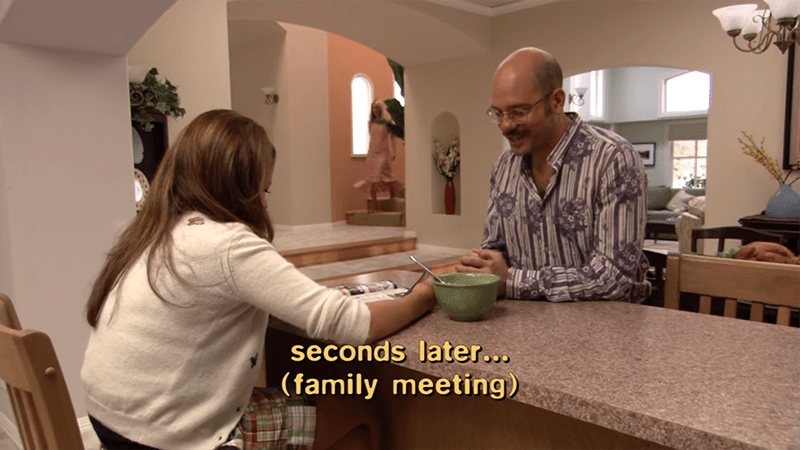
After Tobias’s yell of “Family meeting!” is repeated in the background of Lindsay’s subsequent scene, the phrase returns in a quieter form:
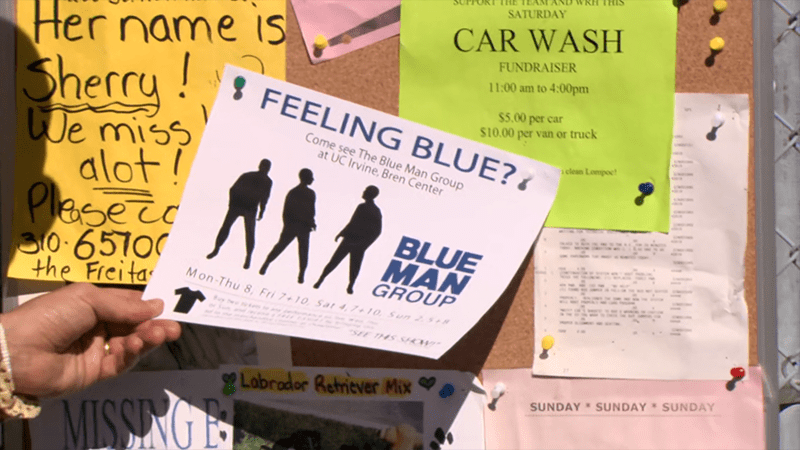
Tobias continues to be a magnet for homosexual situations, walking past a gay couple on the pier just before he sees the Blue Man Group advertisement:
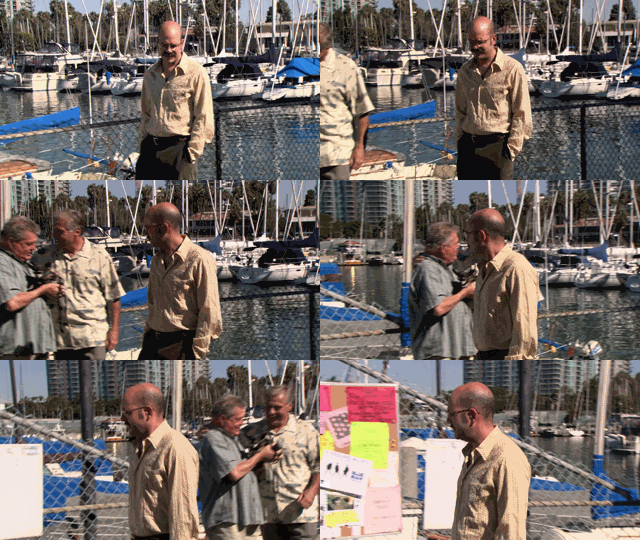
This shot is mirrored later this season in Burning Love, when Tobias passes a lesbian couple before encountering another pier-side notice board.
The Blue Man Group are scheduled to perform at UC Irvine, where George Michael would later attend university in season 4.
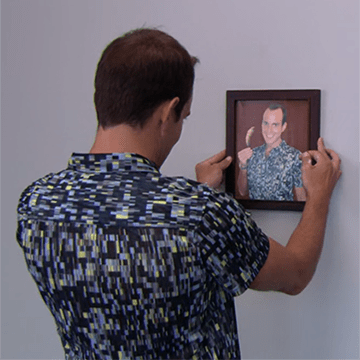
Gob attempts to hang a portrait of himself holding a frozen banana, replicating a portrait of George Sr. that can be seen in Bluth Company boardroom in numerous season 1 episodes (first appearing in the Pilot).
The incriminating documents hidden in the Bluth Company walls are a callback to Top Banana, where we learned George Sr. hid a large sum of (presumably ill-gotten) money in the walls of the banana stand.
The contract between George Sr. and Saddam Hussein appears to have been signed in blood.
When Buster, Lucille and Oscar are watching the news together in the penthouse, we can hear the tail-end of John Beard’s news report: “…And a seal attack. Meet one surprised bather, coming up!” The camera then immediately pans over to Buster, foreshadowing his seal attack later this season in Out on a Limb.

Before we discover it’s actually George Sr. posing as Oscar in the final scene, multiple hints are laid out cluing us in. Buster is visibly uncomfortable with the massage he gets from him, George Sr. eyes up the briefcase several times before slyly taking it from Gob (the camera briefly even diverts attention to the briefcase changing hands), and of course, the telling line, “You don’t need some piece of *beep* uncle hanging around.”
It’s the first of many such scenes throughout the series (the twin we believe to be Oscar is actually George Sr, or vice-versa, and it isn’t revealed to us until after) – and it serves a particularly special place here since it’s also setting up the twist at the end of season 2 finale The Righteous Brothers, where a more full-time switch takes place. The device becomes even more prevalent in the Netflix era when the two sport the same hairstyle, though a lot of seasoned viewers are able to tell the two apart when they’re on screen based on Jeffrey Tambor’s performance alone (the twins have key distinctions in tone of voice and body language).
At the beginning of the episode, it is mentioned that Lindsay and Tobias sleep in twin beds. In the end of the episode, when Lindsay is admitted to hospital with a fever, we see the two of them sharing twin beds in the hospital.
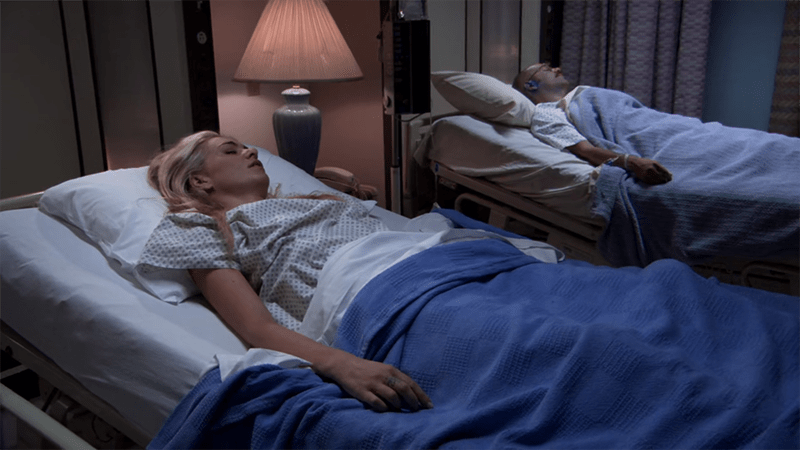
Also note the blue paint around Tobias’s ear (furthermore, the narrator mentions here that Lindsay is admitted to hospital with a fever of “104,” which may be a subtle allusion to season 1, episode 4, Key Decisions – the first episode where a Bluth was admitted to hospital).
The final scene in the “On the next” replicates the closing moments from the Pilot, where Michael previously visited George Sr. in prison. The original exchange went as such:
MICHAEL: You love it here?
GEORGE SR: Oh, I’m having the time of my life. (exchanges a gang handshake with another inmate) Hey, T-Bone.
This time around, it plays out like so:
MICHAEL: You’re glad Tobias is pressing charges?
BARRY: I am having the time of my life. (exchanges a gang handshake with another inmate) Hey, Dr. Hate.
Each shot is framed the same way in both scenes – right down to the zoom-out during the handshake – and they’re even underscored by the same music. There is, however, one additional detail here that wasn’t present in the Pilot: A guard in the background can be heard yelling “No touching!” at the very end (the running gag was not established until the show’s second episode, Top Banana).


 Deconstructing Arrested Development

